
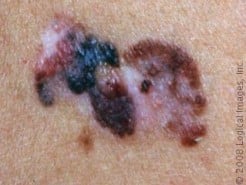
 Skin cancer is the most common type of cancer found in humans, and greater than half of all new cancers diagnosed are skin cancers. Basal cell and squamous cell carcinomas are respectively the first and second most common forms of skin cancer, and nearly half of all Americans who live to age 65 will be diagnosed with one of these types of cancer. These common cancers are usually found in the most sun-exposed parts of the body, appearing in the skin’s top layer as a scaly area or bump that doesn’t heal. They can occasionally bleed. If detected and treated early, these cancers have a greater than 95% cure rate.
Melanoma accounts for only 3% of all skin cancer, but it is the most deadly type. It occurs when there is an uncontrolled growth of the skin’s pigment-producing cells, called melanocytes. These cells may produce a new red, brown, or black lesion on the skin without warning, or they can cause an existing mole to change.
Melanoma tends to spread and becomes more difficult to treat over time, making early detection very important. When found early, melanoma has about a 95% cure rate, but when found in the later stages, the cure rate falls to 9%. Melanoma claims one life every hour.
Identifying the Different Types of Skin Cancer
Basal Cell Carcinoma
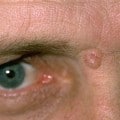
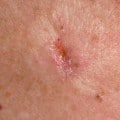
What to look for:
• Skin-colored or pink bump, with tiny blood vessels on the surface
• Scar-like growths on the skin
• Pink or red, dry, scaly spot
Squamous Cell Carcinoma
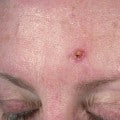
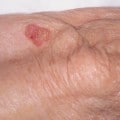
What to look for:
• Small, pink to red, scaly spot
• A larger, deeper bump
• Eventually, the center may bleed or scab over
Melanoma
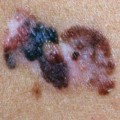
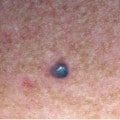
What to look for:
• A: Asymmetry
• B: Irregular border
• C: Multiple colors
• D: Size larger than 6 mm in diameter
• E: Evolution or changes in the mole over time
Other less frequent types of skin cancer include dermatofibroma sarcoma protuberans (DFSP), atypical fibroxanthoma (AFX), and Merkel cell carcinoma, to name a few. These tumors are not common and are usually diagnosed by a dermatologist after a biopsy. A biopsy is a technique used by physicians to remove a small portion of the skin lesion with the patient under local anesthesia. The tissue is then analyzed using a microscope, with results available in a few days.
Last modified on June 4th, 2019 at 7:00 pm